The Power of Struggle – 16 October 2022
Luke 18:1–8
[The writer] uses contrast, rather than comparison, to illustrate the sure and present justice of God. God is not like the judge; that is the point. If a judge who couldn’t care less about either God or his fellow human beings can deliver justice, shouldn’t we expect even more of an answer from God, who does care for all of God’s creation? –– John Fairless
2 Timothy 3:14––4:5
Paul writes to encourage and instruct the younger minister, Timothy. He reminds Timothy that the words of scripture are powerful in several ways: They teach, they rebuke, they correct, and they train in what is right. This power is breathed into these texts by none other than God. Timothy’s main purpose: preach this word of God, and always be prepared to use the word in its proper manner—patiently, in order to correct, rebuke, encourage, and instruct. –– John Fairless
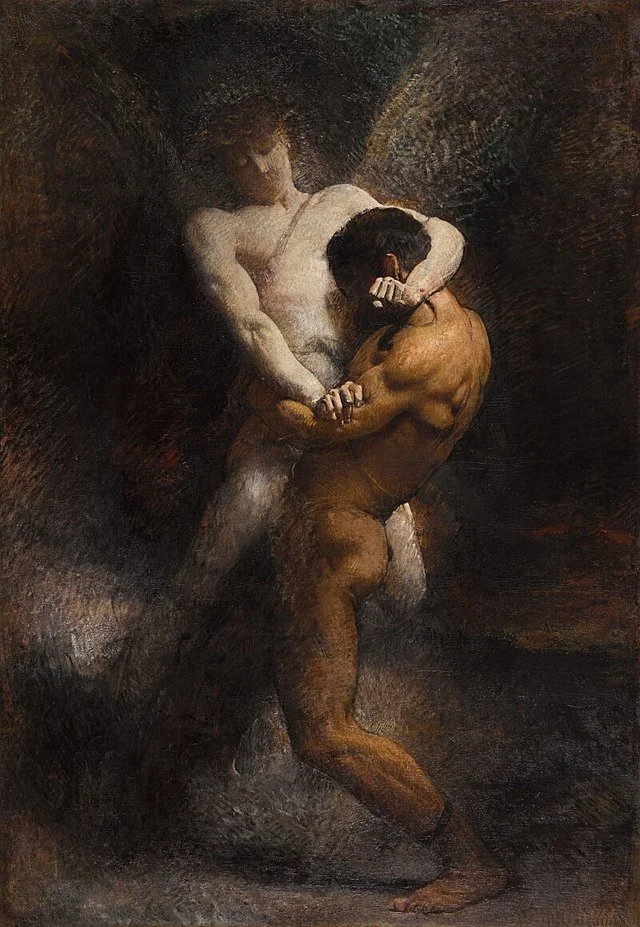
Genesis 32:22–31
One of the most basic tensions that must be resolved, of course, is the fact that the text never names Jacob’s opponent as God, at least not directly. Verses 28 and 30 seem to imply the presence of God, though in a tantalizing manner that leaves us both certain and wondering about the identity of “the man” who engages Jacob in this struggle.
Hosea 12:4–5 offers scriptural commentary on this event, though the wrestler is identified here as both an angel and, perhaps, as God. For the purpose of preaching, it is much less important to struggle with the literal identity of Jacob’s opponent than it is to reflect on what is happening in this encounter.
Jacob—the trickster, the cunning planner—is in trouble as he faces a reunion and potential showdown with his older (and stronger) brother, Esau. His tricks will not help him now; he has reached the end of his own strength. And so, Jacob tries something novel: he prays. Verses 9–12 lie outside the selected reading for today, but are nonetheless important to the context. It has been noted that this is the first recorded prayer in the Bible; heretofore, people have spoken with God and seen God in visions and other manifestations. But this is the first time we have a human who is said to have prayed.
Is the ensuing struggle with . . . the answer to his prayer? Certainly, there is ample thought material here for preachers (and congregations) to consider how Jacobs’ prayer, “Deliver me...” (v 11) is answered as he is delivered, in the course of the struggle, from the very unworthiness and self-effort that he confesses. In his struggle, Jacob learns to depend, literally, on a power greater than himself. He is transformed by this encounter, to the point of receiving a new name: formerly, he was Jacob (“grasps the heel” or “pulls the leg”—a joker!). Now he is Israel (“struggles with God”…).
The transformational moments of our lives are most often those that involve struggle. Perhaps it is the honesty that comes when we have nowhere else to turn, no remaining pretensions to grasp. When our strength is gone, there is God’s strength that remains. –– John Fairless
John P. Fairless is senior minister of the First Baptist Church of Gainesville, Florida.
Homily Service 43, no. 4 (2010): 72–82.