From the Archives: "Instrumental Music in the Liturgy"
Each month, our blog features articles from the archives of Liturgy. Our goal is to share the wisdom from decades past so that we might celebrate the work and insights of these excellent ministers and scholars.
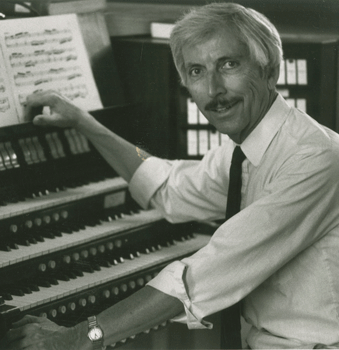
Addressing the question of whether and how wordless music may find a home in worship, Philip Gehring––university organist and professor at Valparaiso University in Indiana for over three decades––explores definitions of beauty, the use and danger of music’s emotional impact, taste, excellence, forms, and sacredness. He asks, as well, whether an amateur musician, a young person just learning or someone whose proficiency is not to the highest standards, should offer music in worship. His answer brings forward his amalgam of the criteria for worship music: the fit of the music to the intention of the liturgy, whether the piece of music is carefully chosen and good, and whether the congregation can hear the devotion of the musician. Quality and sacredness are the bottom line. –– Melinda Quivik
Selected Quotes from "Instrumental Music in the Liturgy"
~ ~ ~
I have been told by some that the choice of music for the church is too important to be left to musicians, who will naturally be “elitist” in their selections. Be that as it may, it is the parish musician who has, or ought to have, the expertise and the responsibility to make judgments about music.
~ ~ ~
There are reasons, in certain situations, to prefer the performance of a devoted amateur to that of a bored professional, if the choice comes to that, but the reasons usually have nothing to do with the quality of the music produced.
~ ~ ~
Quality is imputed to the music, but taste is an attribute of the person hearing it.
~ ~ ~
Sensuous appeal can mask the fact that a certain composition has really very little to offer the mind or the imagination. This can be true not only of the maudlin, sentimental music that passes for church music in some quarters, but also of some seemingly “respectable” baroque music in which sonic splendor hides a genuine poverty of formal cohesion and expressive power.
~ ~ ~
Liturgical music ought to reach toward a transcendence of cultural barriers; at the very least, it ought to avoid reinforcing them.
~ ~ ~
Words are abstractions through which we can communicate ideas, but music is embodiment and through it we can share feelings. Added to words, music can help us not only to understand what is said but to appropriate it into our own being.
~ ~ ~
Philip Gehring was, for thirty-one years professor of music and university organist at Valparaiso University, Valparaiso, Indiana, as well as a composer and performer of organ recitals.
Philip Gehring, “Instrumental Music in the Liturgy,” Liturgy 6, no. 3 (1987): 40–45.